
How We Build a Live Edge Table: From Raw Slab to Heirloom Furniture
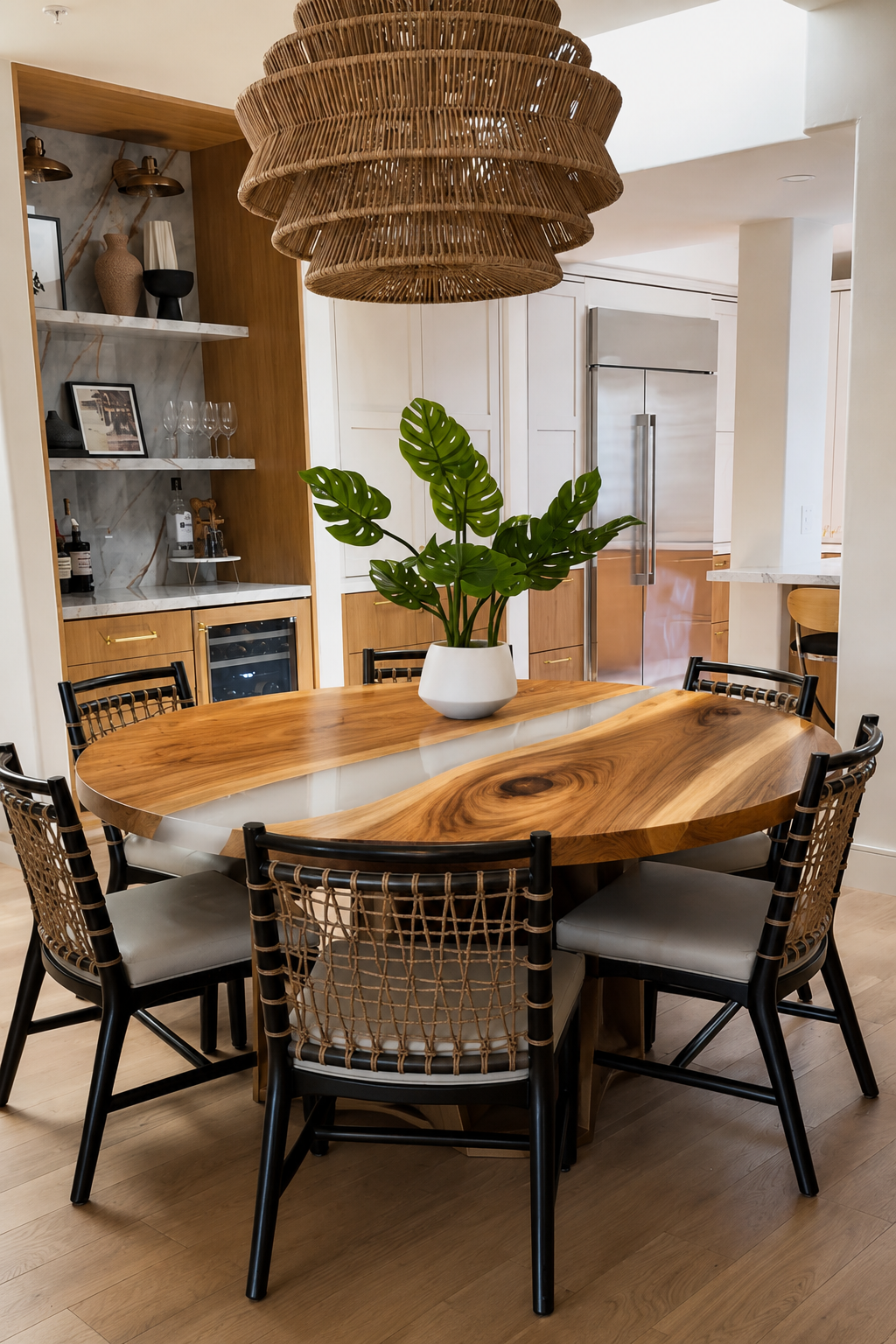
A beautiful slab of wood does not automatically make a beautiful—or well-made—table.
When most people shop for a custom live edge table, they naturally focus on what they can see: the grain, natural edge, color of the wood, resin, and base.
But some of the most important differences in a live edge table are found in the things you can't see once the table is finished.
How long was the slab allowed to dry?
Was the wood gradually stabilized before kiln drying?
Was it properly sanitized?
Is the tabletop actually flat?
Were cracks and voids properly prepared?
Was the resin poured under controlled conditions?
What type of finishing products were used?
At Indigenous by La Rue, our process can begin years before a client ever selects their slab.
For many of our pieces, transforming a tree into heirloom furniture is a slow process of drying, stabilizing, kiln cycling, sanitizing, precision flattening, filling or resin work, sanding, finishing, and final fabrication.
We don't believe that process should be rushed.
Here's how we do it.
Step 1: It Begins With Selecting an Exceptional Slab
Every Indigenous by La Rue table begins with the wood.
We work with distinctive hardwoods including walnut, acacia, monkey pod, tamarind, and other exceptional species, but species is only the beginning.
We look at the entire slab:
Grain • movement • coloration • live edges • knots • natural voids • figuring • spalting • width • length • thickness • overall character
We also consider what the wood could eventually become.
A spectacular slab for a coffee table isn't necessarily the right slab for a 12-foot dining table.
For a custom project, we consider the client's desired dimensions, seating requirements, architecture, design preferences, resin choices, and base before determining which slabs make sense.
That's why one of our favorite parts of the process is allowing clients to select the actual slab that will become their table.
But long before that selection happens, the wood has already begun one of the most important stages of its journey.
Step 2: We Give Our Slabs Time to Dry
Wood moves.
Even after a tree has been cut, the wood still contains moisture. As that moisture leaves, the slab can shrink and change.
Trying to move a large hardwood slab too quickly into an aggressive drying environment can increase the risk of warping, splitting, checking, and other unwanted movement.
So we give our wood time.
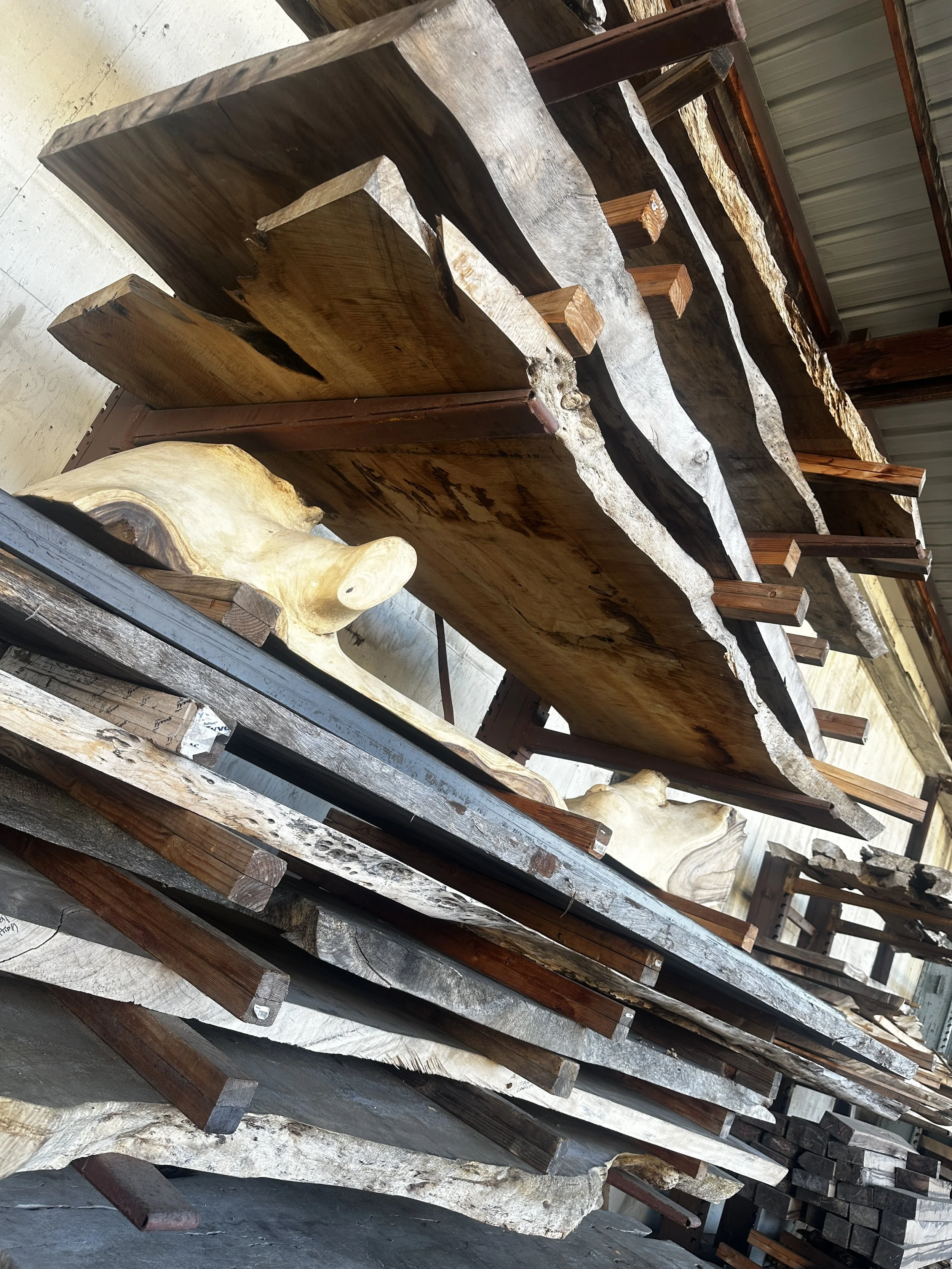
At Indigenous by La Rue, our slabs are allowed to dry for a minimum of approximately a year and a half.
For most of our slabs, however, the process is considerably longer.
Many spend approximately three to five years drying and stabilizing before they ever go into production.
During this period, we slowly dry and prepare the wood rather than attempting to force the process.
We are not trying to make a slab ready to sell as quickly as possible.
We are preparing it for its eventual life as furniture.
Step 3: We Gradually Prepare the Wood for Its Final Kiln Cycle
Kiln drying is important, but how the wood reaches the kiln matters too.
We don't want to take a large slab that has not been adequately prepared and suddenly subject it to an extreme change in environment.
Instead, our slabs are slowly dried and prepared for their final kiln cycle.
Once the wood has reached the appropriate stage, it goes through a final kiln-drying cycle that generally lasts approximately three to four months before production.
This allows us to continue reducing and stabilizing moisture under controlled conditions.
That final kiln cycle has another extremely important purpose.
Step 4: Kiln Drying Also Sanitizes the Wood
A live edge slab came from nature.
That is part of its beauty—but it also means insects or larvae can potentially exist within natural wood.
Our kiln process isn't only about moisture.
It also provides a sanitation cycle designed to eliminate wood-eating insects within the slab.
A homeowner may never think about this when looking at photographs of finished furniture.
We do.
Because when you're bringing a massive piece of natural hardwood into someone's home, what is happening inside that wood matters too.
Step 5: Our Ready Slabs Continue Receiving Annual Sanitation
Once a slab has completed our drying process, it doesn't necessarily become a table immediately.
If it hasn't been designated for a specific project, the slab goes into our ready stack, where clients can choose from wood that has already gone through our preparation process.
But even then, we're not finished maintaining it.
Every year, slabs remaining in our ready inventory go back into the kiln for approximately one week for another sanitation cycle.
Think about what that means when you walk through our slabs looking for your table.
The piece you select may have already spent three, four, or five years being dried, stabilized, maintained, and prepared before you ever laid eyes on it.
To us, that history is part of the furniture.
Step 6: Then Comes Precision Flattening
Once a slab has been selected for production, we need to create a truly functional tabletop.
This is one of the areas where our standards are particularly important.
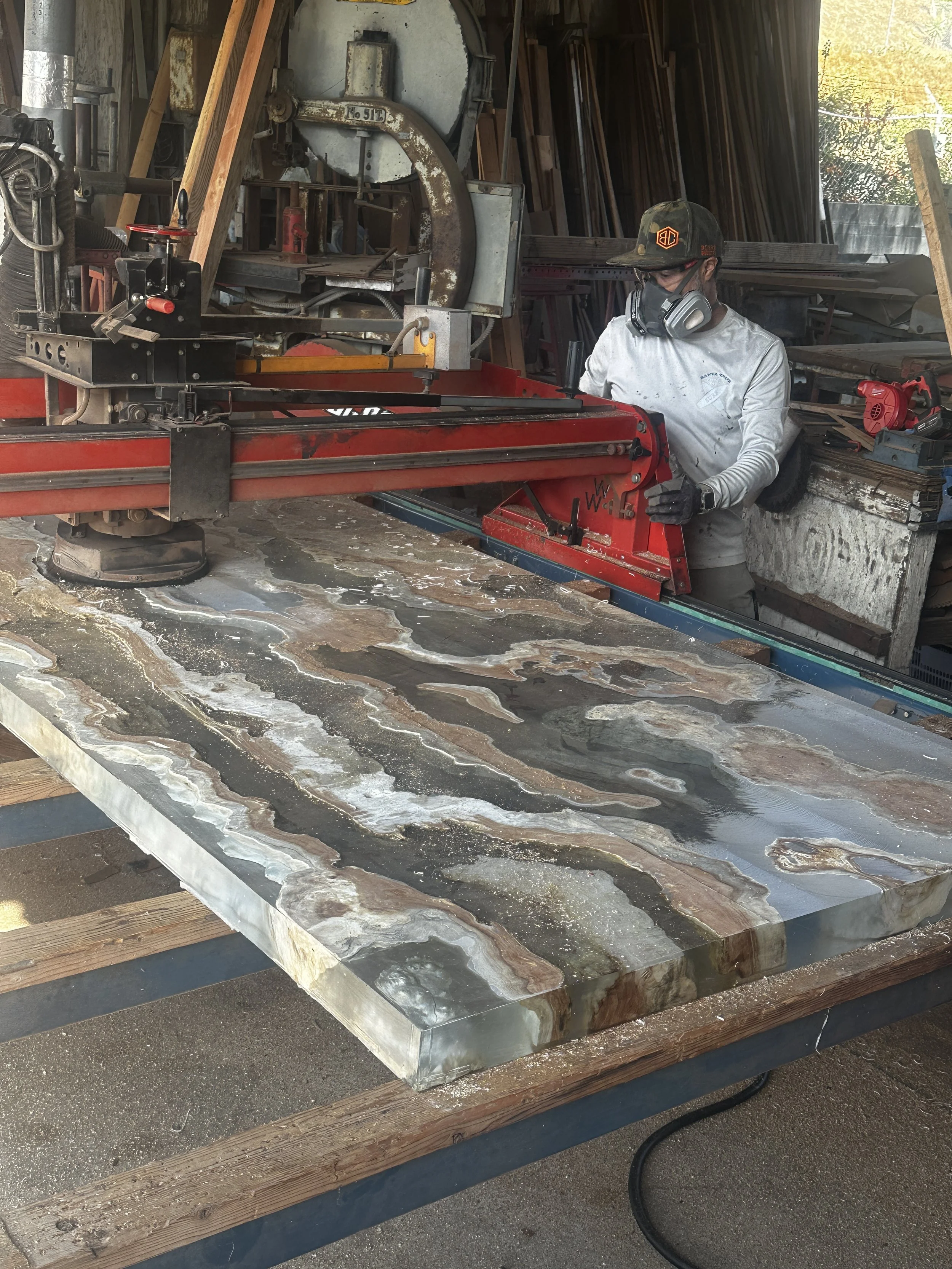
At Indigenous by La Rue, we use a 26-foot-long by 6-foot-wide planer to machine-plane our slabs flat on both sides.
There are furniture makers who describe large slabs as being hand planed. Hand craftsmanship absolutely has an important place in furniture making, but for establishing the geometry of an enormous tabletop, our standard requires greater precision.
A variation approaching 3/4 of an inch is not acceptable by our standards.
Because ultimately, this isn't just a sculpture.
It's a table.
And no one wants a wobbling plate, glass, cup, or saucer.
Our large-format planer allows us to create a consistent, flat foundation across very large pieces of natural wood before we begin the detailed filling, resin, sanding, and finishing work.
The bigger the table, the more important that precision becomes.
Step 7: We Evaluate Every Crack, Void & Natural Characteristic
Once the slab is flat, we can determine exactly what it needs.
This is where live edge furniture is fundamentally different from standardized manufacturing.
Every slab presents a different set of characteristics.
There may be small cracks.
Natural voids.
Knots.
Spalting.
Irregular edges.
Openings within the wood.
Some characteristics need stabilization. Others deserve to remain prominent because they're precisely what makes that slab extraordinary.
Our objective is not to make nature perfectly uniform.
It is to refine and stabilize the wood without erasing the story of the tree.
Step 8: Small Cracks Are Hand Filled
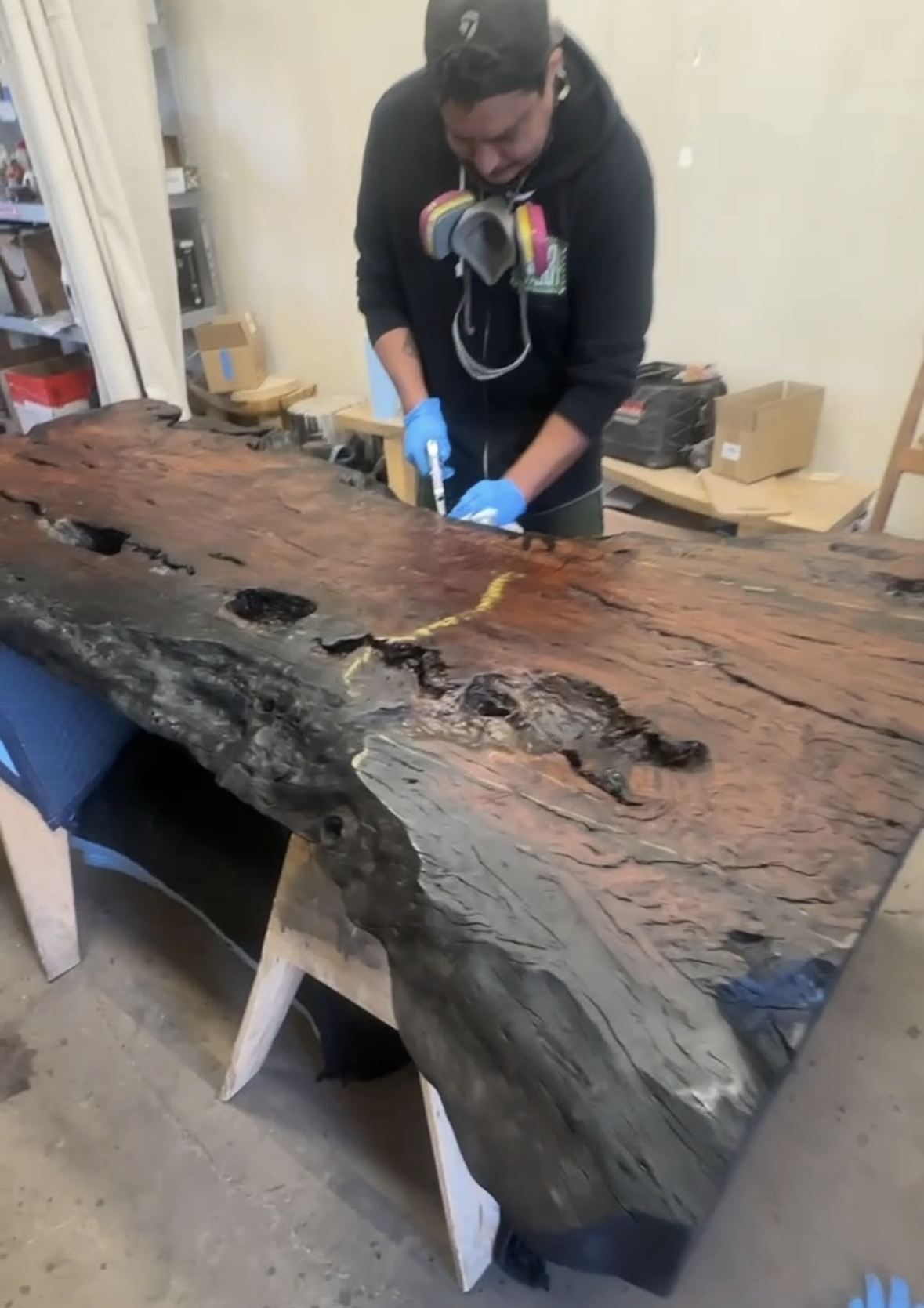
If a slab will remain predominantly natural wood, smaller cracks and voids can be carefully filled by hand.
This allows us to address individual areas while preserving the organic character surrounding them.
We don't believe every knot, line, void, or imperfection needs to disappear.
Some of the most interesting features in a finished live edge table are characteristics that would have been considered imperfections in mass-produced furniture.
In a one-of-a-kind slab, they become identity.
Step 9: Other Slabs Are Prepared for Resin
Some slabs call for a different approach.
Large natural openings, dramatic edges, or a client's specific design may lead us to prepare the slab for a resin mold.
Depending on the piece, we can incorporate clear, black, smoked, or other resin treatments.
Resin doesn't have to dominate the table.
One of our favorite uses is clear resin because it allows us to preserve extraordinary natural architecture within the wood.
Instead of cutting away a dramatic edge or filling a void with something visually heavy, clear resin can allow you to see the original form of the tree through a smooth, functional surface.
Resin can also make a table deeply personal.
Objects and mementos that represent a family's history can sometimes be incorporated into a design, transforming the table into something beyond furniture.
It can become a tribute to a person, place, memory, or family legacy.
That is when resin stops being a trend and becomes storytelling.
Step 10: Our Resin Rooms Are Temperature & Humidity Controlled
A quality resin pour isn't simply about selecting a good resin.
The environment matters.
At Indigenous by La Rue, our resin pouring rooms are temperature and humidity controlled.
Maintaining controlled conditions allows us to create a more consistent environment during the pour and curing process, supporting proper interaction and adhesion between the resin and wood and helping us achieve a higher-quality pour.
This becomes particularly important when working with large natural slabs, deep voids, and substantial amounts of resin.
Instead of allowing changing shop temperatures and humidity to dictate the conditions of the pour, we control the environment around it.
It's another step that completely disappears by the time you see the finished table.
But it matters to us.
Step 11: Resin Needs Time to Cure
Once resin has been poured, we wait.
Depending on the amount and type of resin used, curing can take anywhere from approximately one day to a week.
Again, our philosophy is not to rush the material simply to move the table into the next stage.
Once the resin has properly cured, the excess needs to be removed.
Depending on the project, we may sand away that excess or flatten the tabletop again, bringing the resin and hardwood back into the same precise plane.
Only then do we begin the progressively finer surface work.
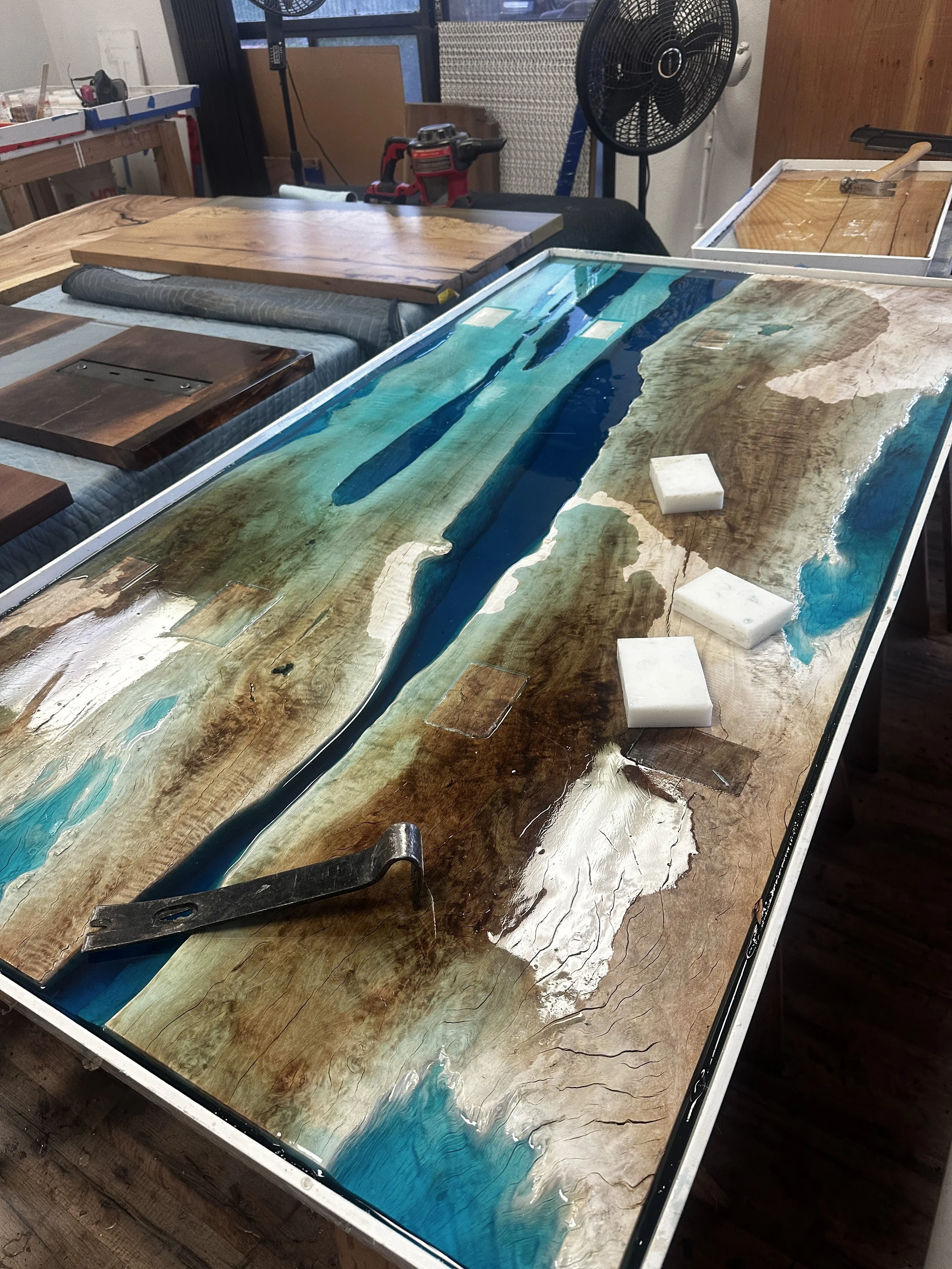
Step 12: Sanding Creates the Surface You Actually Feel
Flattening and sanding are not the same thing.
Our large-format planer establishes the geometry of the tabletop.
Sanding creates the refinement.
After machining, filling, and resin work, the table is progressively sanded to remove machining marks, refine the wood, smooth transitions, and prepare the entire surface for finishing.
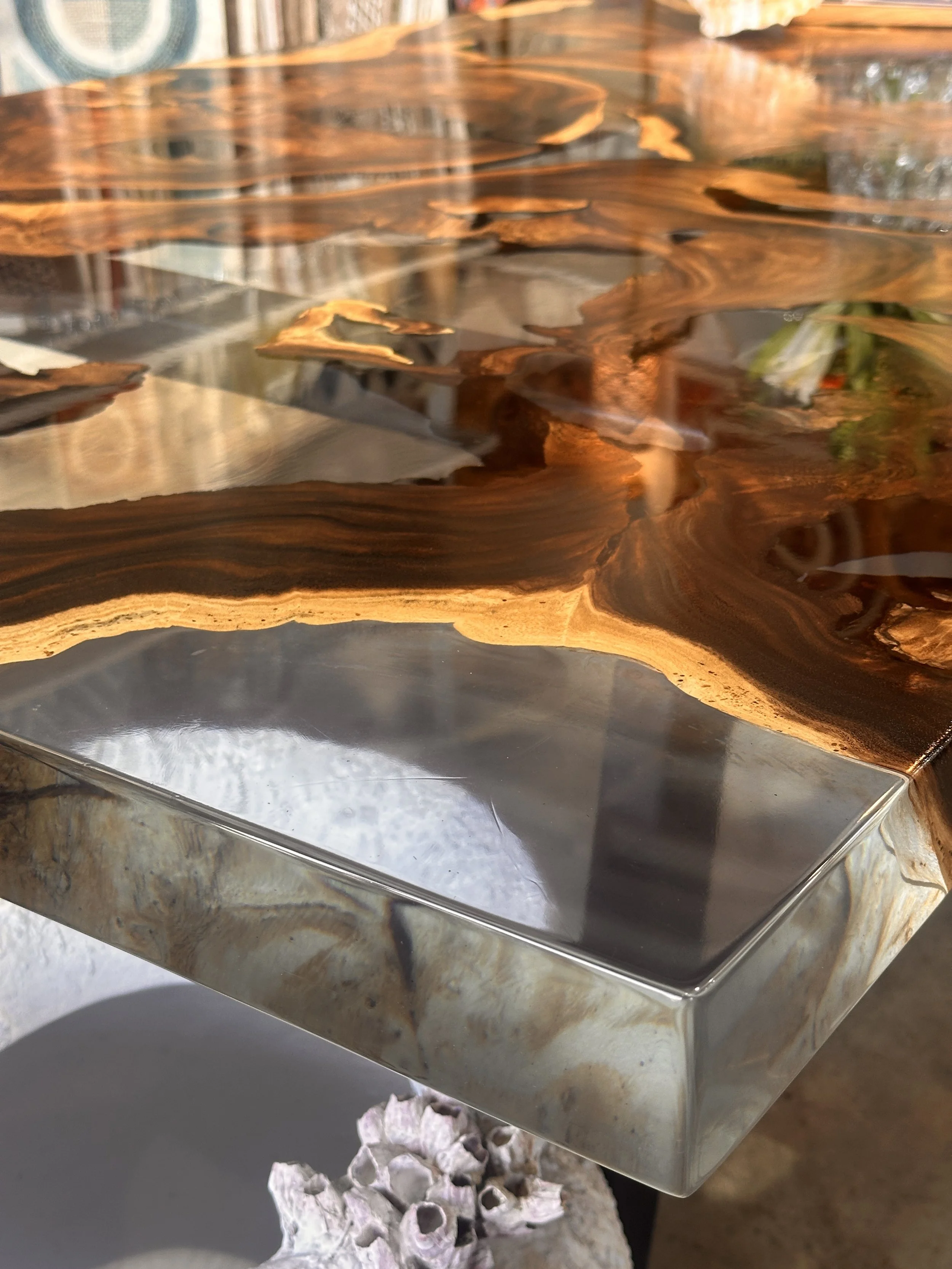
This is particularly important where wood meets resin.
Run your hand across a finished table and those transitions should feel intentional.
Look across the surface as light moves over it and it should feel refined.
We believe a luxury table shouldn't only look impressive from across the room.
It should become even more impressive when you walk up and touch it.
Step 13: The Finish Has to Survive Real Life
The finish may be one of the least glamorous parts of discussing a custom table, but it is one of the most important.
Because the finish is the part your family actually lives with.
Hands touch it.
Dinner plates sit on it.
Glasses get set down.
Food is served.
Spills happen.
The table gets cleaned.
Sunlight reaches it.
Children grow up around it.
That surface needs to be considered for life beyond the showroom.
At Indigenous by La Rue, most of the finishes we use are zero-VOC, while the remaining finishes—as well as our resin systems—are low-VOC.
VOC stands for volatile organic compounds.
We choose high-quality professional finishing products with both performance and the materials used in the process in mind.
But a zero- or low-VOC designation alone isn't enough.
The finish still needs to perform.
It needs to protect the wood while allowing its natural grain, coloration, figuring, and character to remain the focus.
We don't choose a finishing product simply because it is inexpensive or quick to apply.
Our goal isn't to create a table that looks fantastic only on the day it's delivered.
We're building it for everything that happens after delivery.
Step 14: The Base Is Engineered Around the Table
A table base has two jobs.
It needs to look right.
And it needs to work.
Large hardwood and resin tabletops can carry substantial weight. The base therefore needs to provide appropriate support while remaining proportional to the slab.
Placement matters as well.
An extraordinary base isn't very extraordinary if everyone sitting at the table keeps hitting it with their knees.
Depending on the project, we can incorporate metal, wood, pedestal, architectural, or sculptural bases.
The dimensions, weight, seating requirements, and overall design of the table all influence that decision.
The base should look as though it belongs to the table—not as though someone chose it afterward.
Step 15: Final Finishing Happens in Our San Marcos Workshop
Eventually, a slab that may have spent years in preparation reaches its final stages.
Our finishing work is completed at our San Marcos workshop in San Diego County.
This is where all of those individual decisions finally come together:
The slab.
The flattening.
The natural edges.
The fills.
The resin.
The sanding.
The finish.
The base.
The proportions.
The details.
Before the table leaves us, we examine the completed piece as furniture—not simply as a slab of beautiful wood.
Because once it reaches the client's home, it needs to do something much more important than photograph well.
It needs to live there.
What Should You Ask Before Buying a Live Edge Table?
If you are comparing custom live edge tables, don't judge them only by photographs or price.
Ask the maker about the process.
How long was the wood allowed to dry?
Was it gradually stabilized before kiln drying?
How long was the final kiln cycle?
Was the slab sanitized for wood-eating insects?
How was the tabletop flattened?
How are cracks and voids stabilized?
If resin is used, are temperature and humidity controlled during pouring?
What finishing products are used?
How is the base designed for the size and weight of the slab?
Those questions tell you far more about a piece of furniture than a photograph ever could.
Two live edge tables can look remarkably similar online when they're brand new.
The processes behind them can be completely different.
Why the Things You Can't See Matter So Much
By the time one of our tables reaches a client's dining room, most of our process has disappeared.
You cannot see the minimum year and a half of drying.
You cannot see the three to five years many of our slabs spend drying and stabilizing.
You cannot see the final three- to four-month kiln cycle.
You cannot see the annual sanitation cycle a slab receives while waiting in our ready inventory.
You cannot see it passing through our 26-foot-long by 6-foot-wide planer.
You cannot see the temperature and humidity being controlled while its resin cures.
You may never know from looking at the table that most of our finishes are zero-VOC and the remaining finishes and resin are low-VOC.
But all of those decisions are part of the finished piece.
That is why we don't believe you can accurately compare custom live edge furniture based solely on a picture and a price.
The quality of a table is determined as much by what happened before you saw it as by what you see when it arrives.
A Live Edge Table Should Outlast a Trend
We don't think of our tables as disposable décor.
The tree existed for decades—sometimes much longer—before the wood ever reached us.
Then the slab may spend several more years in our care before becoming furniture.
We believe that deserves respect.
Our job isn't to erase everything nature created and force the wood into a standardized shape.
It is to stabilize it, refine it, protect it, and turn it into something functional without losing the characteristics that made the slab extraordinary in the first place.
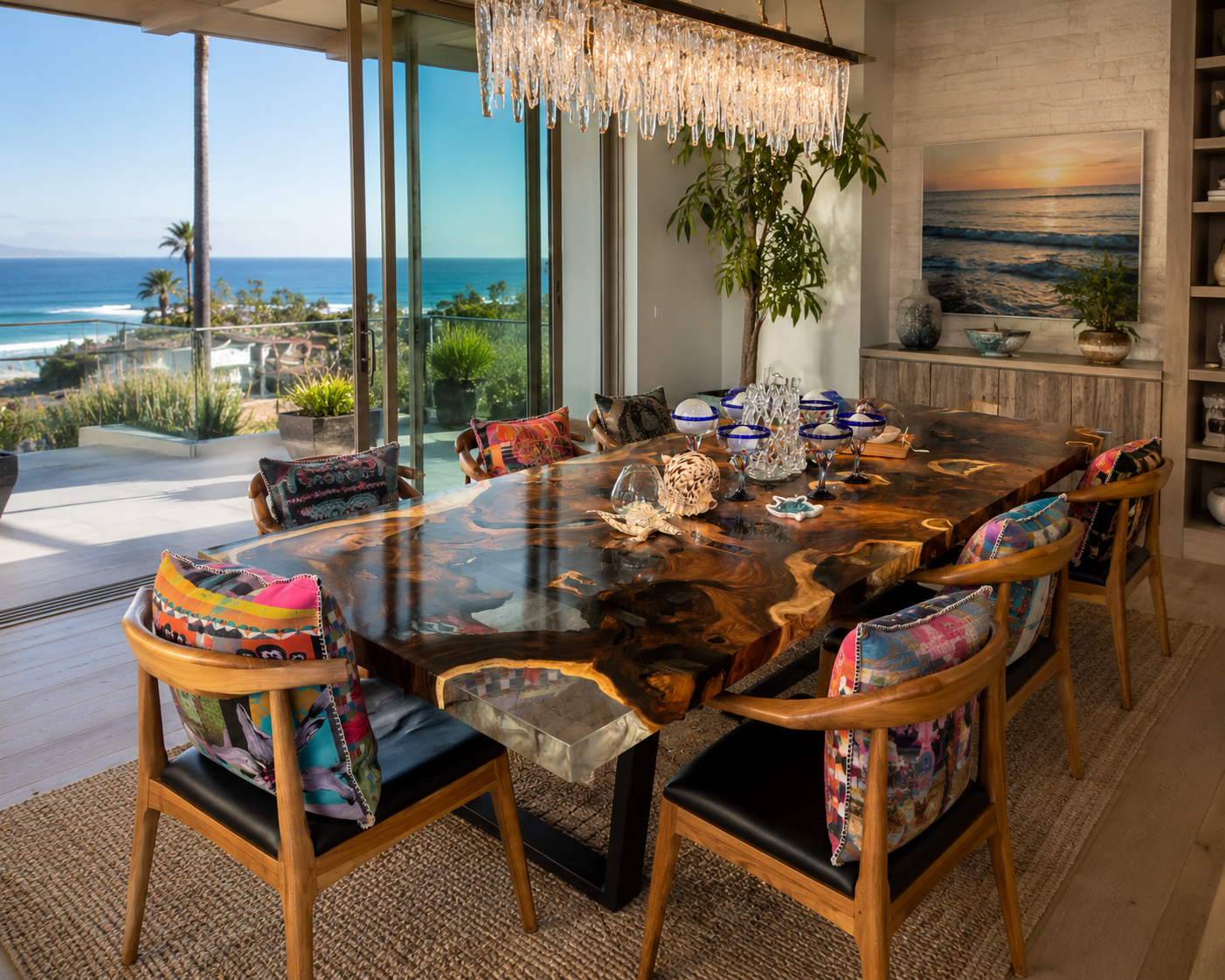
A truly custom dining table eventually becomes part of the history of a home.
Birthdays happen around it.
Holidays happen around it.
Children grow up around it.
Friends gather around it.
Stories are told around it.
Eventually, the table begins carrying memories that have nothing to do with the people who originally built it.
That is the difference between making furniture for a trend and building furniture with the intention of becoming an heirloom.
Custom Live Edge Tables Made in San Diego
Indigenous by La Rue creates custom live edge dining tables, resin tables, conference tables, coffee tables, and one-of-a-kind furniture from our San Diego County operation.
We serve clients throughout San Diego, La Jolla, Del Mar, Rancho Santa Fe, Solana Beach, Encinitas, Coronado, and beyond, and create custom furniture for clients throughout the United States.
Homeowners, interior designers, architects, builders, and commercial clients can participate in selecting an individual slab and customizing the dimensions, resin, base, and overall design.
Because the process begins with an actual tree instead of a standardized manufacturing template, no two finished pieces can ever be exactly alike.
Ready to create your own table? Explore Indigenous by La Rue's available live edge tables and slabs, or contact us to begin designing a one-of-a-kind piece.